
Asserting that India and Pakistan can unite through a common market, Defence Minister Pranab Mukherjee on Friday invited Islamabad to work jointly for developing a trade and economic block, "which could even be a matter of envy for blocks like Europe
"We hope to reach a solution by July 2007," the minister said after the ASEAN-India economic minister's meeting held in Cebu, Philippines.
This will be External Affairs Minister K Natwar Singh's first visit to Pakistan after assuming office.
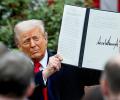
'April 9 announcement of slapping a 125% tariff on Chinese goods has brought the focus back to China, making this new phase feel like a repeat of the original conflict.'

India should simultaneously prioritise domestic exploration and production of more oil and gas in the country, and ensure we retain diversified suppliers for imports, points out former foreign secretary Ranjan Mathai.

We must bring a laser focus on our own interests, and define our friends and foes more clearly instead of trying to live by somebody else's rules. We must grow up, think for ourselves, think India First, asserts R Jagannathan.
A 'framework agreement' as a precursor to a free trade arrangement will be signed when the prime minister is in Indonesia next week.
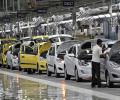
With the Indo-Pak dialogue in tatters and the respective armies exchanging fire across the Line of Control, an unexpected opportunity has presented itself for boosting trade between the two countries.
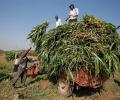
The World Bank on Tuesday raised the growth forecast for the Indian economy to 7 per cent for the current fiscal year on the back of recovery in agri sector and rural demand. World Bank had in June projected India to grow at 6.6 per cent for FY24. According to the World Bank Report released on Tuesday, India's growth continues to be strong despite a challenging global environment.
The Association of Southeast Asian Nations is expected to sign a free trade agreement with India next week, Malaysian International Trade and Industry Minister Rafidah Aziz has said.
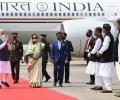
The South Asian nations could script a new history of cooperation and prosperity that could serve as an example for other nations, notes Dr Rahul Mishra.
Taking India's Look East policy a step further, Prime Minister Manmohan Singh on Saturday announced visa-on-arrival facility for citizens of Cambodia, Vietnam, Philippines and Laos; and emphasised the need to speed up the finalisation of a free trade agreement in services and investment between India and South East Asian nations.

India and the Association of Southeast Asian Nations signed an FTA in goods in August last year and are engaged in intense negotiations to expand this pact to include services and investments.

Hectic parleys through out the year led to finalisation of the long-awaited India-ASEAN Free Trade Agreement on services and investment during the 20th India-ASEAN Commemorative Summit held in New Delhi at the end of the year.

Countries that have signed the RCEP agreement can start negotiations with India for joining the pact once New Delhi submits a written request stating its intention for the same, according to a declaration. On November 4 last year, India walked out of mega free trade agreement RCEP (Regional Comprehensive Economic Partnership) as negotiations failed to address New Delhi's outstanding issues and concerns. The remaining 15 member countries have signed RCEP agreement and have stated that the pact would remain open to India.

According to a senior commerce department official, talks between India and the Association of South East Asian Nations (Asean) - the 10-country trading bloc - have hit a roadblock, with some of the advanced developing countries demanding greater flexibilities from India.

Analysts believe Tesla will first focus on building the Model Y brand before expanding -- both in terms of volume and models.
Close on the heels of a Free Trade Agreement with Thailand, India is now focusing on signing more such trade deals with member countries of Association of South East Asian Nations, MERCOSUR
The FTA will provide Indian trade and industry with access to a large and vibrant market in a region that is increasingly prosperous. This market is bound to expand further as the Asean trading bloc is already in talks with countries like China, Japan, South Korea, Australia and New Zealand for free or preferential trade pacts.

The India-Asean free trade agreement (FTA) in merchandise goods has failed to realise its full potential, even as the deal was implemented in January 2010 to facilitate greater trade in the region. As a result, reduction of duties on several products might get delayed.

Indian firms feared they would lose business if US ratified the Trans-Pacific Partnership agreement with 11 other countries.

This will hit the Indian plantation sector as it is not competitive, cost wise, and will be wiped out from the domestic market as well as from the export market, according to D P Maheshwari, president, United Planters' Association of Southern India.

Asked for China's comments on India not joining the RCEP deal over concern of cheap Chinese products potentially harming its domestic industry, Chinese foreign ministry spokesman Geng Shuang told the media in Beijing on Tuesday that China welcomes India joining the deal.
India has offered further pruning of its negative list of 560 items for Association of South East Asian Nations on which there will be no duty cuts
In a major effort to promote regional trade, India and six other South Asian countries have finalised the agreement on free trade area, which will come into effect from January 1.
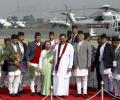
Prime Minister Narendra Modi and leaders of other South Asian Association for Regional Cooperation countries will meet in Kathmandu on Wednesday with an aim to revitalise the regional grouping and make it a major platform to fuel economic growth through liberalised trade and combat challenges of terrorism and climate change effectively.

India is the only country which has a negative list incorporated in a trade pact with Asean.
India-ASEAN Summit, scheduled for December 17 in Thailand, has been postponed as crisis-ridden South-East Asian country is unable to host the meet.

'Geopolitically and diplomatically it's a very difficult situation for India.'
The Centre said on Wednesday it had made a good offer for the proposed Free Trade Agreement with the Association of South East Asian Nation and is awaiting ASEAN's reactions to it.
The leaders also adopted the Islamabad Declaration for the SAARC summit.
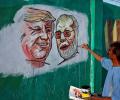
Existing trade deals, especially the 2009 pact with the Asean bloc, have been panned by the Centre for not boosting exports but flooding the domestic market with cheap imports. Subsequently, New Delhi has called for reviewing FTAs with Japan and South Korea. Going by that, a trade deal with the US is unlikely to be beneficial, say experts.

Currently, India imposes 30-45 per cent duty on textile products from Pakistan.
'It seems a wiser decision to pull out at the right moment than regret after joining the pact,' explains Dr Rahul Mishra.

The Asean secretariat hopes the meet may be able to iron out existing wrinkles raised by India. Since there had been no significant progress on the matter over the past two years on most issues, New Delhi is yet to decide on the invite.

Sources said China was forcefully pushing for inking the deal during the RCEP summit later in the day, which was seen as an attempt to counter-balance the impact of its lingering trade war with the US as well as to project the region's economic might to the West.
